Your child comes home from school with a note saying they were screened for scoliosis and that a possible spinal curve was detected. What does that mean? Does your child actually have scoliosis? Do they need an X-ray? And what happens next?
A school scoliosis screening is designed to identify children who may have a spinal curve and could benefit from further evaluation. A screening result does not necessarily mean that a child has scoliosis or will need treatment. Instead, it is an opportunity to take a closer look. Scoliosis is one of the most common spinal deformities affecting children and adolescents. It is also one of the most misunderstood. Understanding what happens after scoliosis screening in schools can help parents know what to expect and when to seek an evaluation.
What Does It Mean If My Child Fails a School Scoliosis Screening?
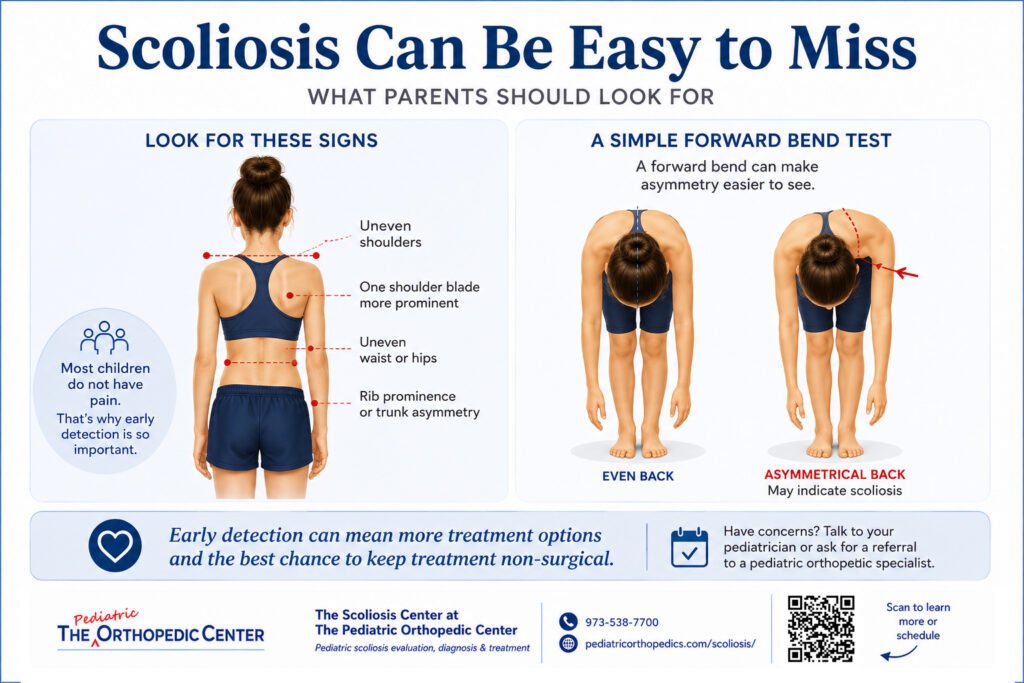
A school scoliosis screening is typically designed to identify children who may have a spinal curve. During the screening, a child may be asked to perform a forward bend test, in which they bend forward while a healthcare professional looks for signs of asymmetry in the back. A scoliometer may also be used during the forward-bend test to measure the degree of rotation in the child’s torso. A reading that meets the screening threshold may result in a referral for further evaluation.
A screening result is not the same as a diagnosis. A child may have a positive screening result without having scoliosis, while another child may have a spinal curve that requires monitoring or treatment. Parents should also understand that scoliosis is often painless. This means a child may not have any symptoms or realize that a curve is developing. School nurses, pediatricians, and other healthcare professionals can play an important role in helping detect scoliosis before a parent or child notices a change.
Does a Positive Scoliosis Screening Mean My Child Has Scoliosis?
No. A positive or abnormal screening result means that further evaluation may be appropriate; it does not automatically mean that your child has scoliosis. During an evaluation, a pediatric orthopedic surgeon considers several factors, including the child’s age, physical examination, spinal alignment, and whether there are signs that the curve is progressing.
Age is particularly important because scoliosis can behave differently depending on when it develops.
- Infantile scoliosis occurs in children ages 0–3. These curves may sometimes resolve with treatment such as serial casting.
- Juvenile scoliosis occurs between approximately ages 3–10. This type of scoliosis is uncommon and may require additional evaluation for an underlying cause.
- Adolescent scoliosis occurs from approximately age 10 through skeletal maturity and accounts for the majority of cases seen by pediatric orthopedic specialists.
A child’s age, growth remaining, and other findings can all influence how a possible spinal curve is evaluated and managed. If your child is referred after a school screening, there is no reason to panic. The purpose of the follow-up evaluation is to determine whether a curve is actually present and, if so, what type of curve your child has and whether it needs to be monitored or treated.
What Happens During a Pediatric Scoliosis Evaluation?
A pediatric scoliosis evaluation begins with a detailed medical history and physical examination. The physician will evaluate the child’s posture and spinal alignment and look for signs of asymmetry. The child’s age and stage of growth are also important. When a child is still growing, there is more time for a spinal curve to progress. Understanding how much growth remains helps the physician determine how closely the curve should be monitored and whether treatment may be appropriate.
The evaluation may also include a neurologic examination, particularly when there are findings that could suggest an underlying spinal condition. Certain findings may warrant additional investigation. These can include a curve in a very young child, a high left thoracic curve, neurologic symptoms, loss of developmental milestones, bowel or bladder changes, numbness or tingling, or certain skin findings along the midline of the back.
The Scoliosis Research Society recommends appropriate evaluation based on the child’s age, examination findings, and characteristics of the curve. When there are concerning findings, additional imaging such as an MRI may be recommended to look for an underlying cause.
Will My Child Need an X-Ray After a Scoliosis Screening?
Not every child who has a positive school scoliosis screening will automatically need an X-ray. The decision to obtain imaging depends on the child’s examination and the findings that led to the referral. When imaging is appropriate, X-rays can provide important information about the presence and size of a spinal curve. Because children with scoliosis may need imaging over time to monitor curve progression, minimizing radiation exposure is an important consideration.
One of the advances in scoliosis care is the EOS X-ray system, which can capture detailed images of the spine using substantially less radiation than conventional X-rays. This can be particularly valuable for children who require repeated imaging during growth. If an MRI is recommended, it serves a different purpose. MRI can provide detailed images of the spinal cord and surrounding structures and may be recommended when there are specific findings that raise concern about an underlying spinal condition.
How Is a Scoliosis Curve Measured and Diagnosed?
If a spinal curve is identified during an evaluation, imaging can help determine its size and characteristics. The degree of the curve is an important part of determining whether a child needs observation, treatment, or continued follow-up. However, the curve measurement is not the only factor that matters.
A pediatric orthopedic surgeon also considers the child’s age, skeletal maturity, how much growth remains, and whether the curve is changing over time. Two children with curves of the same size may have very different treatment recommendations depending on their age and stage of growth. This is one reason why an evaluation is important after a school screening. A screening can identify a child who may have a curve, but a complete evaluation provides the information needed to understand what that curve means for the individual child.
Does Every Child with Scoliosis Need Treatment?
No. Many children with scoliosis do not need immediate treatment. For some children, the appropriate approach is simply to monitor the curve over time. This is particularly true when the curve is relatively small and the child does not have concerning symptoms or findings.
The goal of monitoring is to watch for curve progression as the child grows. Follow-up appointments and, when appropriate, repeat imaging allow the physician to determine whether the curve is remaining stable or changing. Scoliosis treatment is individualized. The recommended approach depends on the size of the curve, the child’s age and skeletal maturity, and how the curve is behaving over time. For adolescent scoliosis, the outlook is often encouraging. When scoliosis is identified early and appropriately managed, the vast majority of children can be treated without surgery.
When are Observation, Bracing, or Surgery Recommended?
Treatment for scoliosis is best thought of as a progression based on the individual child’s needs rather than a single treatment that applies to everyone. For smaller curves, observation may be recommended. The child continues normal activities while the curve is monitored during growth.
For children with curves that are more likely to progress, bracing may be recommended. The purpose of a brace is to help prevent further curve progression while the child is still growing. The timing of bracing is important, which is why physicians consider both curve size and skeletal maturity when making treatment recommendations. Physical therapy and scoliosis-specific exercise programs, such as the Schroth method, may also be incorporated into care depending on the child’s individual circumstances.
For curves that progress despite appropriate non-surgical treatment, or for curves that reach a severity where surgery is recommended, spinal fusion may be considered. Surgical treatment has changed significantly over the past several decades. Modern techniques, including advanced screw-placement technology, blood-conservation strategies, and updated pain-management protocols, have improved the surgical experience and recovery process for many patients.
Importantly, a referral after a school scoliosis screening does not mean your child will need a brace or surgery. The purpose of early evaluation is to understand the curve and identify the appropriate next step.
Schedule a Scoliosis Evaluation with The Pediatric Orthopedic Center
If your child has been screened for scoliosis at school and the screening result recommends follow-up, an evaluation with a pediatric orthopedic specialist can provide answers and help determine whether additional testing or treatment is needed. Scoliosis is common, often painless, and very manageable when appropriately monitored. Early evaluation gives families the information they need to understand whether their child has a spinal curve, whether it is likely to progress, and what treatment options may be appropriate.
At The Pediatric Orthopedic Center, our pediatric orthopedic surgeons have extensive experience evaluating and treating scoliosis and other spinal deformities in growing children and adolescents. Our team can evaluate your child’s screening findings, determine whether imaging is appropriate, and develop an individualized plan based on your child’s age, growth, curve, and overall health.
If your child has received a referral following a school scoliosis screening, contact The Pediatric Orthopedic Center to schedule an evaluation.
This article is for educational purposes only and is not intended to replace professional medical advice, diagnosis, or treatment. If you have concerns about your child’s spine or scoliosis screening result, speak with your child’s pediatrician or a pediatric orthopedic specialist.