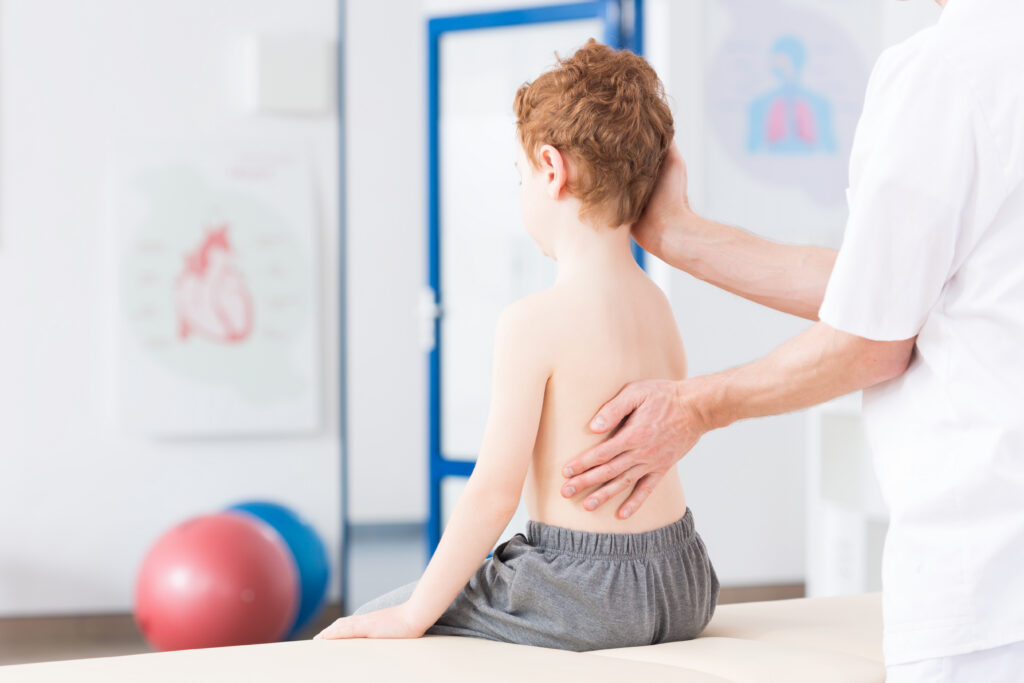
When parents hear the word scoliosis, it’s natural to have questions. How serious is it? Will it get worse? Will my child need a brace, or even surgery?
The good news is that advances in early detection, imaging, and treatment have dramatically improved outcomes for children with scoliosis. In fact, the vast majority of children diagnosed today can be successfully treated without surgery when their condition is identified early.
Here’s what families should know about scoliosis, how it’s diagnosed, and the treatment options available today.
What Is Scoliosis?
Scoliosis is a three-dimensional curvature of the spine that causes it to curve and rotate. While many people think of scoliosis as simply a sideways curve, it actually affects the spine in multiple planes.
Approximately 80% of scoliosis cases are classified as idiopathic scoliosis, meaning there is no identifiable underlying cause. However, scoliosis can also develop as a result of congenital abnormalities, neurological conditions, connective tissue disorders, muscular disorders, or other medical conditions. That’s why a thorough evaluation is so important.
The Different Types of Idiopathic Scoliosis
Idiopathic scoliosis is classified by the age at which it develops, because age plays an important role in treatment decisions and long-term outlook.
Infantile Scoliosis (Birth to Age 3)
Infantile scoliosis is uncommon and occurs more often in boys. Parents often notice a rib prominence or asymmetry during bathing or dressing.
Many infantile curves can improve with careful observation, while others require specialized casting that gently guides the spine as a child grows. Surgery is reserved for select cases and is generally delayed whenever possible to allow the lungs and spine to continue developing.
Juvenile Scoliosis (Ages 3–10)
Juvenile scoliosis is less common but deserves careful attention because children in this age group have a higher likelihood of having an underlying spinal condition.
For this reason, MRI imaging is often recommended to rule out neurological causes. If an underlying problem is identified and treated early, the scoliosis may improve or even resolve.
Adolescent Idiopathic Scoliosis (Age 10 Through Skeletal Maturity)
This is the most common form of scoliosis.
It occurs most frequently in girls and typically develops during periods of rapid growth. Because adolescent scoliosis is usually painless, children often don’t realize they have it until it is noticed during a routine physical examination, school screening, or by a parent.
Why Early Detection Matters
One of the biggest factors influencing successful treatment is early diagnosis.
During growth spurts, spinal curves can progress rapidly. A curve that has remained stable for months can worsen significantly during periods of accelerated growth.
Today, thanks to improved screening and earlier intervention, approximately 96% of children with adolescent idiopathic scoliosis can be managed without surgery, a remarkable improvement compared with decades ago.
How Is Scoliosis Diagnosed?
Evaluation begins with a detailed medical history and physical examination. A pediatric orthopedic specialist will evaluate:
- Age when spinal asymmetry was first noticed
- Growth history
- Family history of scoliosis
- Neurological symptoms
- Developmental milestones
- Overall health and medical history
Because scoliosis often runs in families, children with a family history should be monitored closely during adolescence.
The Physical Exam
One of the most important screening tools is the forward bend test.
As a child bends forward, the physician looks for asymmetry of the ribs or back. A simple instrument called a scoliometer measures the amount of trunk rotation.
If the measurement reaches five degrees or greater, additional evaluation with X-rays is typically recommended.
When Is Additional Testing Needed?
Although most scoliosis is idiopathic, certain findings suggest that further evaluation is necessary.
MRI imaging may be recommended if a child has:
- Neurological symptoms
- Bowel or bladder changes
- Abnormal reflexes
- Skin abnormalities over the spine
- A curve developing before age 10
- A left-sided upper thoracic curve
- Rapidly progressing scoliosis
Identifying these conditions early allows physicians to treat the underlying problem before permanent spinal deformity develops.
Low-Dose EOS Imaging
Children with scoliosis often require periodic imaging throughout their growth.
At The Pediatric Orthopedic Center, EOS imaging technology dramatically reduces radiation exposure while providing highly detailed images of the entire spine.
Compared to conventional X-rays, EOS technology offers:
- Up to 90–97% less radiation exposure
- Full-body standing images
- Three-dimensional spinal analysis
- Improved treatment planning
Minimizing radiation is especially important because children with scoliosis often need imaging over several years.
Treatment Options
Treatment depends on several factors, including the child’s age, skeletal maturity, and the degree of spinal curvature.
Observation
Small curves are often monitored with periodic examinations and imaging to ensure they are not progressing.
Nutrition
For mild curves, maintaining healthy bone strength is important. Adequate calcium and vitamin D intake may support bone health and may be recommended as part of treatment for mild curves.
Schroth Physical Therapy
Schroth therapy is a scoliosis-specific exercise program that focuses on:
- Improving posture
- Strengthening core muscles
- Breathing techniques
- Increasing body awareness
These exercises are frequently used alongside bracing to improve overall outcomes.
Bracing
For moderate curves in growing children, bracing remains one of the most effective ways to prevent curve progression.
Modern three-dimensional braces are significantly more advanced than earlier designs and are customized for each child’s specific spinal curve.
When worn consistently during growth, bracing can dramatically reduce the likelihood that surgery will become necessary.
Surgical Treatment
Surgery is generally considered only for larger curves or those that continue progressing despite non-operative treatment.
Advances in spinal surgery have transformed outcomes for children with scoliosis.
Modern techniques include:
- Highly accurate surgical navigation
- Motion-preserving technologies for select patients
- Blood conservation strategies
- Advanced pain management
- Faster recovery and shorter hospital stays
Many patients now return home within two days after surgery and gradually resume school and sports over the following weeks to months.
Why a Specialized Scoliosis Center Makes a Difference
Successful scoliosis care requires more than just a surgeon, it requires a coordinated team.
A comprehensive scoliosis center brings together:
- Pediatric orthopedic specialists
- Physical therapists trained in scoliosis care
- Orthotists who design and adjust braces
- Low-dose imaging technology
- Specialized nursing staff
- Pediatric anesthesiologists and surgical teams when surgery is needed
This collaborative approach helps ensure every child receives personalized treatment while minimizing unnecessary procedures and maximizing long-term outcomes.
The Bottom Line
While a scoliosis diagnosis can feel overwhelming, today’s treatment options are more effective than ever before.
Early detection, careful monitoring, and individualized treatment allow most children to avoid surgery and continue participating in the activities they enjoy.
If you notice uneven shoulders, a prominent rib, uneven hips, or other changes in your child’s posture, schedule an evaluation with a pediatric orthopedic specialist. Identifying scoliosis early provides the greatest opportunity for successful, non-operative treatment and lifelong spinal health.