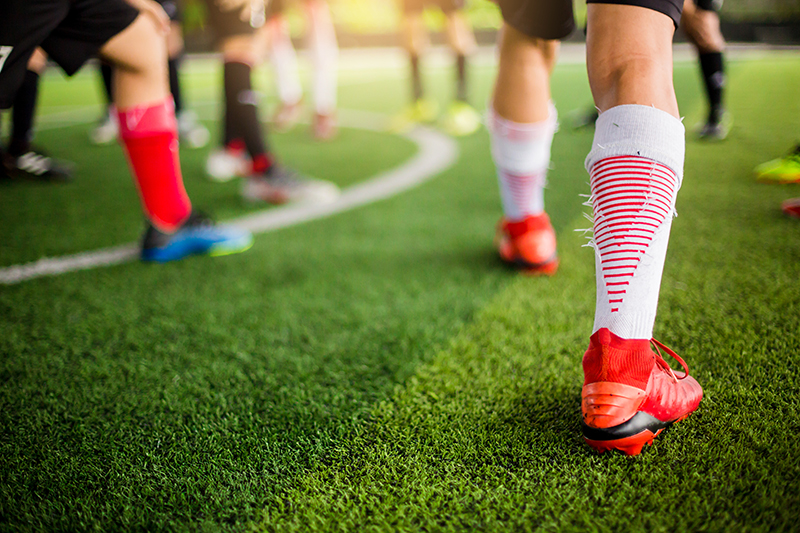
When a child gets hurt during sports, the injury may not affect the same structures it would in an adult. One of the biggest reasons is something adults no longer have: open growth plates. Growth plates are areas of developing tissue near the ends of many of a child’s bones. Because they are softer and more vulnerable than mature bone—and can even be weaker than the surrounding ligaments and tendons—the same force that might cause a sprain in an adult can sometimes cause a growth plate injury in a child.
This is one of the reasons pediatric orthopedic care is different from adult orthopedic care. A young athlete’s bones are still growing, and an injury involving a growth plate needs to be evaluated with that future growth in mind. Most growth plate injuries heal well with appropriate treatment. However, because the growth plate helps determine the future length and shape of the bone, certain injuries require careful treatment and follow-up.
What Is a Growth Plate Injury?
Growth plates, also called physes, are located near the ends of many of the long bones in a child’s body. They are responsible for producing new bone as a child grows. Eventually, once a child reaches skeletal maturity and finishes growing, these areas close and are replaced by mature bone. Until then, growth plates represent a relatively vulnerable part of the developing skeleton.
A growth plate injury occurs when this developing area is damaged. Some injuries happen suddenly, such as during a fall, twist, or collision. Others can develop gradually when a growing athlete repeatedly stresses the same area through sports. Because the growth plate can be weaker than nearby ligaments and tendons, an injury that results in a sprain in an adult may affect the growth plate in a child. That distinction matters. Treating a young athlete isn’t simply a matter of applying adult sports medicine to a smaller patient.
What Causes Growth Plate Injuries in Children and Teens?
Growth plate injuries can occur from both acute trauma and repetitive stress. An acute injury might happen when a young athlete:
- Falls onto an arm or wrist
- Twists an ankle
- Collides with another player
- Lands awkwardly after jumping
- Experiences a direct blow during a contact sport
Repetitive stress is another consideration, especially for today’s young athletes. Children may participate in competitive sports across multiple seasons, play on more than one team, or train in the same sport for much of the year. Repeated activity without adequate recovery can place additional stress on developing bones and growth plates. With an overuse-related injury, symptoms may develop gradually rather than following a single event. Pain may initially occur only after sports but can become more noticeable during activity if the affected area continues to be stressed.
Periods of rapid growth can add another consideration. A child may have the strength and athletic ability to perform at a high level while the skeleton is still developing. That combination is one reason training demands, symptoms, and recovery need to be considered in the context of the athlete’s age and skeletal maturity.
Common Symptoms of a Growth Plate Injury
Growth plate injuries don’t all look the same. Symptoms depend on the bone involved and whether the injury occurred suddenly or developed through repetitive activity. Parents should watch for:
- Pain or tenderness near the end of a bone or around a joint
- Swelling or warmth
- Difficulty moving the injured area
- Difficulty putting weight on an injured leg or ankle
- Limping or favoring one side
- Pain that occurs during or after sports
- Pain that becomes more frequent or intense over time
- A child who stops using an injured arm normally
- Difficulty participating in activities the child could previously perform comfortably
An obvious deformity or severe injury requires immediate medical attention. With overuse injuries, the warning signs can be subtler. A young athlete may initially describe soreness after practice rather than a specific moment when the injury occurred. Pain that repeatedly returns with activity shouldn’t simply be dismissed as part of playing sports. As symptoms progress, an athlete may begin changing the way they move to avoid the painful area or have difficulty participating at their normal level.
Where Do Growth Plate Injuries Most Commonly Occur?
Growth plates are found throughout a growing child’s skeleton, so injuries can occur in several areas. The wrist and forearm are important examples. Falling onto an outstretched hand is a common mechanism of injury in active children, and fractures around the wrist can involve developing bone near the growth plate. The ankle is another area where distinguishing a sprain from a growth plate injury is particularly important. Tenderness around the growth plate after an ankle injury can indicate something more significant than a routine ligament sprain.
Growth-related injuries can also occur around the knee, elbow, shoulder, and other developing areas, depending on the child’s age, sport, and mechanism of injury. Repetitive sports can create their own patterns. Throwing athletes, for example, can place repeated stress on developing areas around the arm, while sports involving running and jumping repeatedly load the lower extremities. The location of the pain—and whether it followed a single injury or developed gradually—can provide important clues during evaluation.
How Are Growth Plate Injuries Diagnosed?
Diagnosing a growth plate injury begins with understanding how the injury happened, where the child hurts, and how the symptoms have changed over time. A pediatric orthopedic specialist will examine the injured area and consider the child’s age and stage of development. The location of tenderness can be particularly important because pain directly over a growth plate may raise different concerns than tenderness over a ligament or muscle.
X-rays may be used when a fracture or growth plate injury is suspected.
However, children’s X-rays aren’t simply smaller versions of adult X-rays. Open growth plates are a normal part of the developing skeleton, and their appearance changes as children mature. Understanding normal pediatric bone development is therefore important when interpreting an injured child’s imaging. Some injuries can also be subtle. If symptoms continue despite an initial evaluation, additional follow-up or imaging may sometimes be needed depending on the suspected injury.
How Are Growth Plate Injuries Treated?
Treatment depends on the type of growth plate injury, the bone involved, the child’s age and remaining growth, and the severity and position of the injury. Many growth plate fractures can be treated without surgery. Depending on the injury, treatment may include:
- Rest or activity modification
- A brace, splint, or cast
- Temporary restriction from sports
- Physical therapy when appropriate
- Gradual return to activity after healing
Some fractures may need to be repositioned so the bone can heal in appropriate alignment. Certain more significant injuries may require surgical treatment, particularly when maintaining alignment of the growing bone is a concern. Treatment for repetitive growth plate injuries also requires addressing the activity that contributed to the problem. Simply reducing pain and immediately returning an athlete to the same training load may not give the area enough time to recover. Return to sports should therefore be gradual and based on the child’s healing and function rather than simply picking up where the athlete left off.
Can a Growth Plate Injury Affect Future Bone Growth?
This is often one of parents’ biggest concerns, and it is also one of the main reasons growth plate injuries deserve specialized attention. Because the growth plate contributes to a bone’s future length and shape, significant damage can potentially interfere with normal growth. Depending on the location and severity of the injury and how much growth a child has remaining, a growth disturbance could cause the bone to develop differently as the child grows. In some cases, that could result in an angular change or a difference in length compared with the opposite limb.
That does not mean every growth plate injury will cause a future growth problem. With appropriate diagnosis and treatment, most growth plate fractures heal without complications. The risk depends on the specific injury, which is why follow-up recommendations are individualized. Children also have significant healing and remodeling potential. The way an orthopedic injury is treated can differ considerably between a young child, pre-adolescent, and teenager because their bones and remaining growth are different.
Contact The Pediatric Orthopedic Center for Growth Plate Injury Care
Kids aren’t just small adults. Their bones are still developing, their growth plates remain open, and the same sports injury can affect a growing child differently than it would an adult. At The Pediatric Orthopedic Center, our pediatric orthopedic specialists diagnose and treat growth plate injuries, fractures, and sports-related injuries in children and adolescents. Treatment takes into account not only the injury itself, but also the child’s age, skeletal development, remaining growth, activity level, and goals.
If your child has pain or tenderness near a joint after a fall, twist, or sports injury—or has pain that repeatedly returns during athletic activity—an evaluation can help determine whether the growth plate or another developing structure has been injured. To schedule an evaluation, call The Pediatric Orthopedic Center at (973) 538-7700.
This information is intended for educational purposes only and should not replace professional medical advice, diagnosis, or treatment. If your child has an obvious deformity, an open fracture, changes in sensation or skin color, or another potentially serious injury, seek immediate medical care.