Broken bones in kids are one of the most common reasons families visit an urgent care or orthopedic office. While we are often asked whether a broken bone is different from a fracture, the two terms mean the same thing. A broken bone, or fracture, occurs when an outside force overwhelms the strength of a bone. Whether your child falls off the monkey bars, twists an ankle during soccer, or collides with another player on the basketball court, the mechanism is the same: the force exceeds what the bone can tolerate.
What are Broken Bones in Kids?
Children are not small adults. Their bones are still growing, changing, and reshaping. Each long bone contains an area called a growth plate, also known as the physis. This is the region where new bone forms, allowing children to grow taller. Growth plates are softer and more vulnerable than the surrounding bone and ligaments. That biological reality changes everything about how fractures occur, how they are treated, and how they heal.
Children also have a thick outer lining around their bones called the periosteum. Think of it as a tough biological sleeve. This structure helps stabilize fractures and limits how much broken pieces can shift. As a result, children’s fractures are often less displaced and less comminuted than those in adults.
Even more fascinating is the concept of remodeling. Remodeling refers to the body’s ability to gradually reshape and correct a bone’s alignment during the healing process. A younger child’s bones can often straighten out small angulations over time as they grow. This is one reason pediatric fracture care must be handled by specialists who understand how growth and healing intersect, specifically board-certified or board-eligible pediatric orthopedic surgeons with advanced training in pediatric bone development.
Most Common Fractures in Kids
Broken bones in kids follow predictable patterns. Certain fractures are far more common because of how children play, fall, and participate in sports.
One of the most frequent injuries is the distal radius fracture, which involves the wrist. When a child falls forward, the natural reflex is to extend the hands. That protective instinct transfers force directly into the wrist, making the distal radius a common site of injury.
Another classic pediatric injury is the greenstick fracture. In this type of fracture, the bone bends and cracks on one side, but does not completely break through. Imagine trying to snap a fresh tree branch. It splinters on one side and bends on the other. That is essentially what happens in a greenstick fracture. It reflects the flexibility of children’s bones.
Similarly, a buckle (torus) fracture occurs when the bone compresses and bulges rather than snapping. These fractures are stable and common in younger children. They often involve the wrist and typically heal quickly with simple immobilization.
Growth plate injuries are also extremely common, especially around the ankle. In fact, ankle injuries rank among the top pediatric sports injuries and are one of the most frequent types of physeal injuries. Because the growth plate is weaker than the surrounding ligaments in children, forces that might cause a sprain in an adult can instead result in a fracture in a child.
Adolescents experience unique patterns of fractures known as transitional fractures. As growth plates begin to close during puberty, the partially hardened bone can fracture in complex ways. Triplane and Tillaux fractures are examples seen in teenagers. These injuries often involve the joint surface and may require surgical precision to restore alignment and protect future growth.
Stress fractures are another category, particularly in adolescent sports medicine. Year-round sports participation and early specialization increase the risk of overuse injuries. Repetitive motion in sports like running, gymnastics, or baseball pitching can gradually overwhelm the bone, leading to a hairline crack.
Symptoms and Causes of Pediatric Fractures
The causes of Broken Bones in Kids are straightforward: falls, collisions, sports injuries, and occasionally accidents like bicycle crashes or playground tumbles. Overuse injuries stem from repetitive strain rather than a single traumatic event.
Symptoms can overlap with those of sprains and strains, making evaluation important. Warning signs include significant pain that worsens with movement, visible deformity, persistent swelling, bruising, and inability to bear weight. An open wound with bone exposure is a medical emergency.
In younger children, symptoms may be subtle. A toddler may simply refuse to use an arm. A teen athlete may describe a deep ache that worsens over time, especially in stress fractures. Because children heal differently, even mild symptoms deserve careful attention.
Diagnosing and Testing for Broken Bones in Children
Diagnosis begins with a thorough physical examination. A pediatric orthopedist evaluates tenderness, swelling, range of motion, and alignment. Gentle palpation can reveal areas of concern, especially near growth plates.
X-rays are the primary imaging tool for diagnosing fractures. They help determine whether the fracture is displaced or nondisplaced, partial or complete, and whether the growth plate is involved. In complex cases, advanced imaging such as CT or MRI may be necessary, particularly for transitional ankle fractures or injuries involving the joint surface.
Understanding the relationship between the fracture and the growth plate is critical. The Salter-Harris classification system categorizes growth plate injuries based on how the fracture line travels through the bone. Certain types carry a higher risk of growth disturbance and require careful management to ensure proper healing.
Precise diagnosis guides treatment decisions. A fracture that appears slightly angled in a toddler may be acceptable because remodeling will likely correct it. The same fracture pattern in a near-adult teenager may require reduction, a procedure to properly realign the bone.
Treatment and Healing for Pediatric Broken Bones
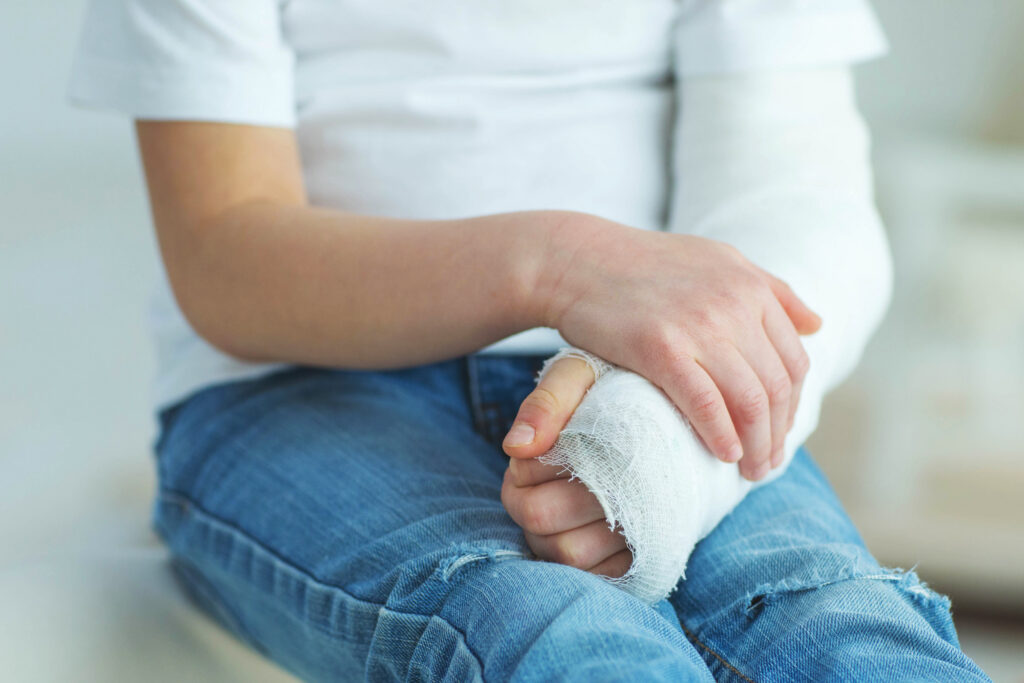
The encouraging news is that more than 90 percent of pediatric fractures can be treated without surgery. Casting and splinting remain the foundation of care. Immobilization allows the body’s natural healing process to unfold.
Healing begins immediately. Blood collects at the fracture site and forms a clot. Over days to weeks, collagen forms a soft callus. Minerals are then deposited, transforming that callus into solid bone. Over months, remodeling reshapes the bone to restore its normal structure.
Some children may not even need formal physical therapy after simple fractures, as their bodies often regain strength and motion naturally during healing.
However, surgery plays an important role in specific cases. If a fracture is significantly displaced and unlikely to remodel, reduction may be required. Some reductions are performed in the office under sedation; others are performed in the operating room. Surgical stabilization with rods, plates, or screws may be necessary for complex fractures, open fractures, or joint injuries.
Joint surface fractures demand precision. If not perfectly aligned, they can predispose a child to early arthritis. Nerve or blood vessel injuries surrounding a fracture also necessitate surgical intervention.
Certain fractures carry a risk of nonunion, meaning the bone fails to heal properly. While rare in children compared to adults, this risk increases in specific locations or when stabilization is inadequate.
Adolescent sports injuries deserve particular attention. Teenagers may be close to skeletal maturity, but their growth plates may still be partially open. Adult orthopedic approaches do not always account for this nuance. An implant placed without regard to growth can cause long-term problems.
This is why pediatric orthopedic care is essential for all ages from infancy through young adulthood. Some adult orthopedic practices begin seeing children at age twelve, but growth plates can remain open well into the late teens.
A pediatric orthopedist trains specifically in these differences. They understand how remodeling potential varies by age, how fracture location affects growth, and how to balance surgical and nonsurgical options. Adolescents involved in competitive sports benefit from specialists trained in adolescent sports medicine who appreciate both performance demands and skeletal maturity.
When to Seek Immediate Care from a Specialist
Certain injuries require prompt evaluation. Open fractures, deep cuts, obvious dislocations, heavy bleeding, or head trauma should be treated in the emergency room or by calling 911. Other red flags include inability to bear weight, severe swelling, deformity, numbness, tingling, or color changes in a limb.
For acute but non-life-threatening injuries, such as suspected broken bones, sprains, or strains from a recent fall or sports injury, our urgent care walk-in clinic provides timely evaluation. Early assessment by a board-certified or board-eligible pediatric orthopedic surgeon ensures proper diagnosis, protection of growth plates, and treatment, whether casting, splinting, or surgery, tailored to your child’s age, skeletal maturity, and activity level, supporting safe recovery and a faster return to daily life.
Schedule a Consultation at The Pediatric Orthopedic Center
Broken bones in Kids are not treated the same way as fractures in adults. Children’s bones are still growing, and their growth plates, healing patterns, and bone biology require specialized expertise. Care from a board-certified or board-eligible pediatric orthopedic surgeon ensures fractures are properly aligned, growth is protected, and recovery supports healthy development into adulthood.
The Pediatric Orthopedic Center has been a leader in pediatric orthopedics for more than 30 years. With three offices throughout northern New Jersey and seven board-certified or board-eligible pediatric orthopedic surgeons, the practice focuses exclusively on children and adolescents. The team understands the complexity of growth plate injuries, adolescent sports injuries, and the unique healing patterns that distinguish children from adults.
From simple buckle fractures to complex joint injuries, from casting and splinting to advanced surgical care, every treatment plan is tailored to a child’s age, growth stage, and activity level. The goal is not just healing today’s fracture but protecting tomorrow’s growth and long-term function.
If your child has sustained an injury or you suspect a fracture, early evaluation ensures accurate diagnosis and optimal healing. Schedule a consultation with The Pediatric Orthopedic Center and give your child’s bones the specialized care they deserve.