Every fall, families arrive at our office with the same question: My child was referred after a school scoliosis screening. What does that mean? For most parents, the referral comes as a surprise. Their child has never complained about back pain, and they may not have noticed anything unusual.
That’s the thing about adolescent scoliosis: it’s usually painless. Because children often don’t know they have a curve, school nurses, pediatricians, and other healthcare providers play an important role in early detection. Here’s what parents should know about scoliosis screenings, what a referral means, and what happens next.
Why Scoliosis and Back-to-School Go Together
Scoliosis is one of the most common spinal deformities in children, and also one of the most misunderstood. Adolescent idiopathic scoliosis is the most common type. It develops from about age 10 through skeletal maturity and accounts for roughly 80% of the scoliosis cases we see. It occurs more frequently in girls, and because it is usually painless, it can be easy to miss. That’s why screening still matters.
As children enter their pre-teen and teenage years, they go through periods of rapid growth. A spinal curve can progress during that time without causing any pain or other obvious symptoms. A school screening may be the first time anyone notices a possible curve.
What Does a School Scoliosis Screening Actually Check?
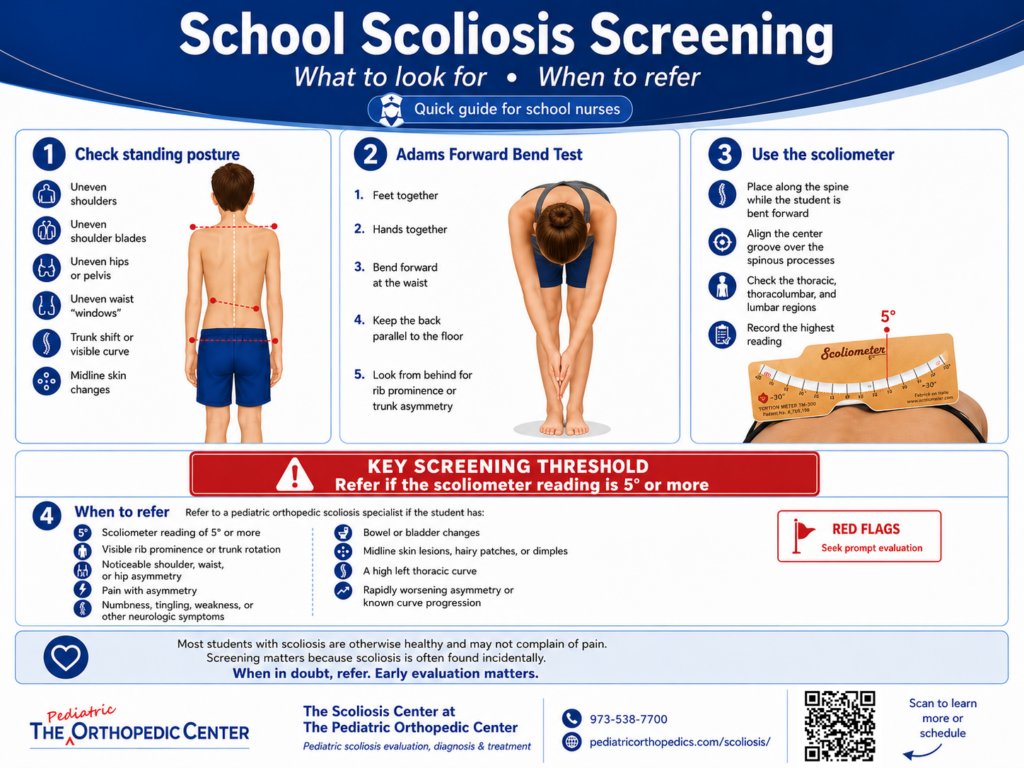
The standard screening tool is the forward-bend test, sometimes called the Adams forward-bend test. The child bends forward while the examiner looks for asymmetry of the ribs or back. A simple instrument called a scoliometer measures trunk rotation. A scoliometer reading of 5 degrees or more is the threshold for referral.
That doesn’t mean a child has significant scoliosis. It means that an asymmetry was detected and that further evaluation may be appropriate. School nurses and pediatricians are often the first line of detection. Their role is important because early evaluation gives families an opportunity to identify a curve while a child is still growing and before it has a chance to progress significantly.
What a Screening Can’t Tell You
A screening is a way to detect a possible spinal curve. It is not the same thing as a diagnosis. The scoliometer measures rotation of the trunk during the forward-bend test. If a screening suggests a possible curve, the next step is determining whether scoliosis is actually present and, if so, how significant the curve is. That’s where a pediatric orthopedic evaluation comes in.
And one of the first questions we ask is not simply, How big is the curve? It’s: How old is the child?
That single fact changes almost everything about the diagnosis, prognosis, and treatment. If your child receives a referral after a school scoliosis screening, don’t panic. A referral does not automatically mean your child will need a brace or surgery. It means that someone noticed an asymmetry that deserves a closer look. The evaluation considers the child’s age, growth, skeletal maturity, curve size, and whether the curve is changing over time. Scoliosis isn’t one disease. Age matters.
Infantile Scoliosis
Infantile scoliosis occurs from birth to age 3. It is more common in boys and is often discovered by a parent who notices a small bump or asymmetry. Many of these curves can resolve with serial casting. Casting provides three-dimensional control of the spine that a brace simply can’t.
Juvenile Scoliosis
Juvenile scoliosis occurs between ages 3 and 10 and is uncommon. It is found much more often in girls. What makes this age group different is the possibility of an underlying intraspinal lesion. About 10–20% of children in this group have one, which is why MRI is an important part of the evaluation. When an underlying lesion is identified and corrected, the curve can disappear in about half of these cases.
Adolescent Scoliosis
Adolescent scoliosis begins around age 10 and continues through skeletal maturity. This is the “bread and butter” scoliosis most people think about, and it represents about 80% of the cases we see. It affects girls roughly seven times more often than boys. And here’s the encouraging news: when caught early, roughly 96% of kids today can be treated without surgery.
What Happens During a Scoliosis Evaluation?
A pediatric orthopedic evaluation starts with a careful history and physical examination.
We want to know when the asymmetry was first noticed, how much growth the child has remaining, and whether there are any symptoms that could suggest something other than typical adolescent idiopathic scoliosis.
The physical examination includes looking at posture and alignment and performing the forward-bend test and scoliometer measurement. Certain findings warrant a more detailed evaluation. These include:
- A curve progressing more than 10 degrees in a year
- Any curve in a child under age 10
- A high left thoracic curve
- Loss of developmental milestones
- Bowel or bladder changes
- Numbness or tingling
- Midline skin findings such as hairy patches, dimples, or lesions
Neurological findings are particularly important because they can indicate an underlying spinal problem. In those situations, an MRI may be recommended.
Will My Child Need an X-Ray?
Not every child who is screened for scoliosis needs the same imaging or treatment. When imaging is appropriate, X-rays allow us to measure the actual spinal curve and monitor whether it is progressing as a child grows.
At The Pediatric Orthopedic Center, we also use EOSedge low-dose imaging. EOS can provide detailed images of the spine while significantly reducing radiation exposure compared with conventional X-rays. That matters because children with scoliosis may need repeated imaging over several years as they grow. The goal is to get the information we need while minimizing unnecessary radiation exposure.
How Is Scoliosis Treated?
Treatment depends on several factors, including the child’s age, curve size, skeletal maturity, and whether the curve is progressing. For smaller curves, observation may be all that is needed. For other children, treatment may include nutritional support, Schroth physical therapy, or bracing. Surgery is reserved for larger curves or curves that continue to progress despite non-surgical treatment. A typical treatment approach is:
| Curve Size | Typical Approach |
|---|---|
| Under 15° | Observation |
| 15°–20° | Vitamin D and calcium supplementation |
| 20°–25° | Schroth physical therapy |
| 25°–40° | Bracing |
| 40°–50°+ | Surgery may be considered, depending on skeletal maturity |
The important thing for parents to understand is that a scoliosis diagnosis does not automatically mean treatment, and treatment does not automatically mean surgery.
Bracing
For growing children with curves in the 25°–40° range, bracing may be recommended to help prevent the curve from progressing. When bracing is needed, our in-house orthotist can measure for and create a custom spinal brace. Bracing a child too early can lead to brace fatigue. By the time a brace is most likely to help, a child who has worn one unnecessarily for an extra year may be burned out and less likely to wear it consistently.
Schroth Physical Therapy
Schroth is a scoliosis-specific physical therapy program that focuses on posture, body awareness, breathing, and exercises designed around the child’s curve.
It can be an important part of non-operative scoliosis treatment.
Surgery
When surgery is recommended, we use advanced technology for precise planning and treatment. This approach reduces operative time, improves precision, and supports safer surgical outcomes. Our Rapid Recovery Pathway helps patients return to daily activities quickly, with patients walking the day after surgery, most discharged within 36 hours, and off narcotics.
A Note for Families of Athletes
A scoliosis diagnosis does not mean your child has to give up the activities they enjoy. The goal of treatment is not simply to treat a curve. It’s to treat the child and help them remain active and healthy while their spine is monitored or treated. For children who do require surgery, most can return to non-collision sports as they recover, with the timing determined by their surgeon and individual progress.
What Should Parents Do After a School Screening?
If your child comes home with a note from the school nurse recommending follow-up, the most important thing is not to assume the worst. A screening identifies a child who may have a spinal curve. It does not tell you how large the curve is, whether it will progress, or what treatment, if any, your child will need. Those questions are answered through an appropriate evaluation. And early evaluation matters because scoliosis is a condition of growth. When we identify a curve early, we have more opportunities to monitor it and, when necessary, treat it without surgery.
The Scoliosis Center at The Pediatric Orthopedic Center
Scoliosis care works best as a team sport. Pediatricians and school nurses are often the front line. Orthotists, Schroth therapists, pediatric orthopedic surgeons, and specialists in neurology, pulmonology, and cardiology may all play a role depending on the individual child.
At The Pediatric Orthopedic Center, our goal is to bring that care together so families have the evaluation, imaging, therapy, bracing, and surgical expertise they need in one place.
If your child received a referral after a school scoliosis screening, or if you’ve noticed a possible change in your child’s posture, we encourage you to schedule an evaluation.
Early detection gives us the best opportunity to keep scoliosis manageable and keep children active.
If you have questions about your child’s spine health or would like to schedule an evaluation, please reach out to The Pediatric Orthopedic Center.
Medical Disclaimer: This information is provided for educational purposes only and is not intended to replace professional medical advice, diagnosis, or treatment. Every child is different, and scoliosis screening results and treatment recommendations may vary based on a child’s age, growth, curve, and individual medical history. If you have concerns about your child’s spine or scoliosis screening results, please consult with your child’s pediatrician or a pediatric orthopedic specialist.