If your child plays sports, you have almost certainly heard about an ACL tear — a teammate who went down without contact, a season that ended in October, a nine-month recovery. ACL tears in young athletes have become one of the most common serious sports injuries in youth athletics, and one of the most misunderstood by parents.
The anterior cruciate ligament (ACL) is one of the major ligaments that stabilize the knee. It connects the femur (thigh bone) to the tibia (shin bone) and controls movement during running, jumping, cutting, and pivoting. When it tears, the knee loses the stability it needs for those movements — which is why a torn ACL is more than a bad sprain and why it requires care from specialists trained in growing bodies.
Here is what sports parents should understand about why these injuries are rising, how to spot one, how they are treated in children, and what actually works to prevent them.
Why ACL Tears Are Increasing in Young Athletes
At The Pediatric Orthopedic Center, our clinicians are seeing more ACL injuries — and younger patients with them — than ever before. We have treated children as young as five for a torn ACL.
Several trends are driving this:
Year-round participation and early specialization. Many young athletes now focus on a single sport at a younger age, with frequent practices, tournaments, and travel schedules that leave few real breaks. Fewer recovery periods mean more accumulated stress on the knee.
Higher levels of competition earlier. Kids are performing advanced movements — hard cuts, rapid deceleration, jump landings — at ages when their coordination and strength are still catching up to their size.
Growth outpacing control. During adolescence, bones lengthen faster than muscles and neuromuscular control can adapt. That temporary imbalance affects balance and landing mechanics and increases the risk of a knee injury during exactly the movements sports demand.
Seasonal spikes. Pediatric orthopedic specialists sometimes talk about “ACL season” — the rise in tears that follows a return to high-intensity play after a layoff. Athletes who come back from an off-season break without reconditioning are asking a knee to handle loads it is no longer prepared for.
The sports where this shows up most often are soccer, basketball, lacrosse, football, volleyball, and skiing — all of which involve jumping, pivoting, rapid acceleration, and sudden stops.
Common Risk Factors for ACL Injuries
Most ACL injuries in young athletes are non-contact. There is no collision, no tackle, no obvious moment of impact — just a sudden stop, an awkward landing, or a quick change in direction. Athletes often describe it as happening out of nowhere.
Known risk factors include:
- Muscle imbalances between the quadriceps and hamstrings
- Weak hip and core muscles
- Poor jumping and landing technique
- Fatigue during practices and games
- Rapid growth spurts affecting balance and coordination
- Insufficient strength and conditioning before a season starts
- High training loads and year-round play with inadequate rest
Female athletes face a meaningfully higher risk than male athletes, particularly in sports like soccer and basketball. The difference is attributed to variations in knee anatomy, joint alignment, landing mechanics, muscle strength, and neuromuscular control. This is a well-established pattern and a good reason for girls’ teams to prioritize structured prevention work. TPOC created the Center for the Female Athlete, led by an all-female team of orthopedic specialists, specifically to address these needs.
Signs and Symptoms of a Torn ACL
The classic presentation is a pop followed by swelling. Many athletes hear or feel a popping sensation in the knee at the moment of injury and cannot continue playing.
Watch for:
- A popping sensation or sound at the time of the injury
- Swelling that develops within hours
- Knee pain, especially when walking or bearing weight
- A sense that the knee is unstable or giving way
- Limited range of motion
- Inability to continue the game or practice
One detail trips up a lot of families: pain sometimes improves substantially in the days after the injury. That does not mean the ligament is intact. If the knee repeatedly gives out or feels unstable during cutting and pivoting, the ACL may no longer be providing adequate support — and continuing to play on an unstable knee risks additional damage to the meniscus and cartilage.
Any significant swelling, instability, or difficulty returning to normal activity after a knee injury deserves evaluation.
How ACL Tears Are Diagnosed
Diagnosis begins with a detailed history and a physical examination. A pediatric orthopedic specialist will ask how the injury happened, what symptoms appeared immediately afterward, and whether there was a pop or a sense of the knee giving way. The exam assesses swelling, tenderness, range of motion, and knee stability through specific clinical tests.
Imaging fills in the rest. X-rays do not show the ACL itself, but they rule out fractures and identify injuries involving the bone — important in children, where a force that sprains an adult ligament can fracture a growth plate instead. MRI is commonly used to confirm an ACL tear and to evaluate the surrounding structures, including the meniscus, cartilage, and other ligaments.
MRI also allows physicians to assess the status of the growth plates, which is a central consideration in planning treatment for a child or teen. Two major growth plates sit near the knee, in the distal femur and proximal tibia, and both must be accounted for in any surgical plan.
Treatment Options for ACL Tears in Children and Teens
Treatment depends on the athlete’s age, activity level, the severity of the tear, and whether the knee remains unstable.
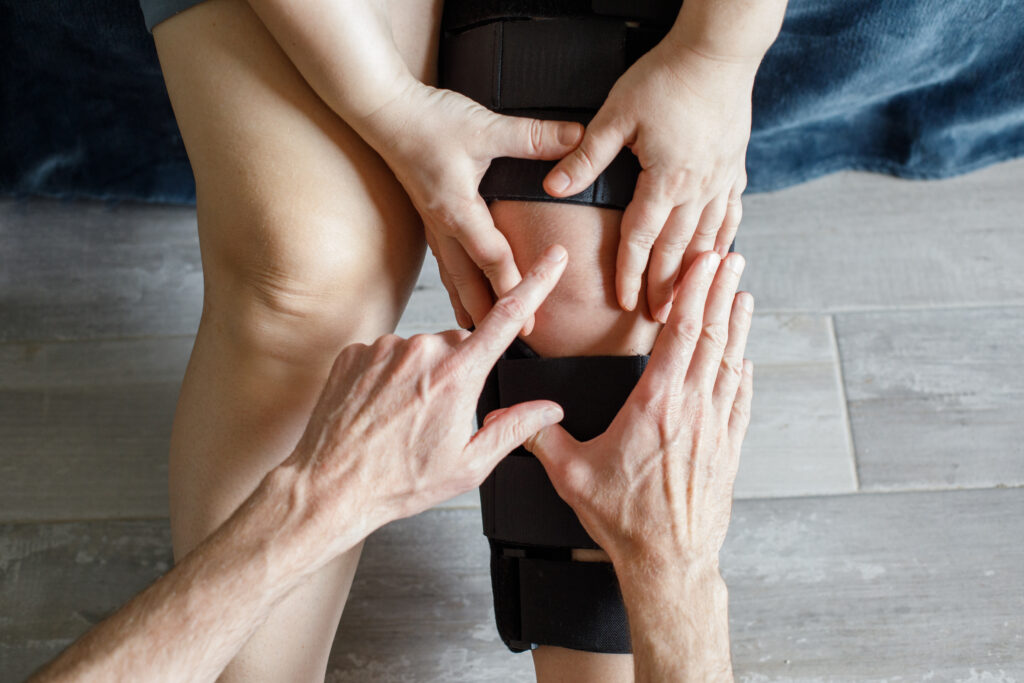
Non-surgical care is appropriate in select cases — typically partial tears where the knee remains stable. It may include physical therapy, strengthening, activity modification, and bracing.
Surgery is required for most complete tears, because the knee needs a functioning ACL for stability and bracing alone does not prevent further injury.
ACL reconstruction (replacement) is the most common procedure. A tendon graft — from the patient or from a donor — replaces the torn ligament, and over time the body incorporates the graft to form a new ACL. Studies show donor grafts carry a higher risk of re-tear, which factors into graft selection for young, active patients.
ACL repair is an option in select cases. Newer arthroscopic techniques allow the native ligament to be reattached and stabilized to the bone rather than replaced. Repair is only appropriate for certain injury patterns, and a pediatric orthopedic surgeon will determine whether an athlete is a candidate.
Both approaches are arthroscopic and minimally invasive, performed through small incisions with a scope for guidance. What matters most for a growing athlete is not which technique is trendiest, but whether the surgeon plans the procedure around that child’s skeletal maturity, anatomy, and athletic goals.
The Role of Physical Therapy in ACL Recovery
Surgery restores the anatomy. Physical therapy restores the athlete.
Recovery after ACL reconstruction in children and adolescents typically takes six to nine months, and some cases run longer depending on the athlete and the sport. Physical therapy is generally done two or three times per week on an outpatient basis, combined with daily exercises at home. That home work is not optional — it is a large share of what determines the outcome.
Rehabilitation focuses on:
- Restoring full range of motion
- Strengthening the muscles around the knee, along with the hips and core
- Improving balance, stability, and coordination
- Retraining proper movement patterns
- Progressing through sport-specific exercises
Before an athlete is cleared to return, physicians and therapists evaluate strength, stability, movement mechanics, and readiness for the actual demands of competition — not just the calendar. Returning too early is one of the clearest risk factors for re-tear, and a second ACL injury is a harder problem than the first.
Physical therapy also matters for athletes treated without surgery, where restoring strength and mechanics is the entire treatment plan.
Can ACL Injuries Be Prevented?
Not entirely — but risk can be meaningfully reduced, and this is the most useful thing parents and coaches can act on.
Effective ACL prevention programs include:
- Strength training for the core, hips, quadriceps, and hamstrings
- Neuromuscular training to improve balance and control
- Jump training focused on proper landing mechanics and shock absorption
- Agility drills that teach safer cutting and pivoting
- Flexibility work to reduce stiffness and improve mobility
- Dynamic warm-ups before every practice and game
- Maintained conditioning throughout the season and off-season
Structured neuromuscular training programs teach young athletes how to move safely during the high-risk activities where these injuries actually happen. Research supports their effectiveness, particularly for reducing the non-contact tears that make up the majority of cases.
The practical version: these exercises belong inside the regular practice warm-up, run by the coach, every session. Prevention work that depends on athletes doing it on their own does not happen consistently. Our pediatric orthopedists can make specific recommendations for a team or an individual athlete.
Parents and coaches also reduce risk by protecting rest and recovery — at least two rest days per week, real time off from a single sport each year, adequate sleep, and multi-sport participation instead of early specialization.
Special Considerations for Growing Athletes and Growth Plates
This is where pediatric care genuinely differs from adult care.
Growth plates, or physes, are areas of developing cartilage at the ends of long bones. They are softer than the surrounding bone and ligaments, and injury to a growth plate can affect future bone growth and alignment if it is not managed correctly. Two of them sit directly adjacent to the ACL’s attachment points at the knee.
Historically, this created a hard problem. Because drilling through an open growth plate risked growth disturbance or deformity, children were often told to wear a brace and stop sports until the growth plates matured, then have surgery. That approach protected the growth plate but left the knee unstable for years.
Modern techniques have changed that. Pediatric orthopedic surgeons can now reconstruct the ACL in growing children while minimizing risk to the developing bone, using approaches selected based on the child’s age, anatomy, and stage of skeletal maturity. Advances in graft fixation and reconstruction technology give surgeons more options than were available a decade ago.
The catch is that this requires pediatric-specific expertise. Adult ACL approaches do not account for open growth plates, and growth plates can remain open well into the late teens — an athlete who looks fully grown may not be skeletally mature. An implant placed without regard to growth can cause long-term problems even when the surgery itself goes well.
When to See a Pediatric Sports Medicine Specialist
Have your child evaluated by a pediatric orthopedic specialist if they experience:
- A pop or popping sensation in the knee during activity
- Swelling that develops within hours of a knee injury
- Pain with weight bearing or walking
- A knee that feels unstable or gives way
- Limited range of motion
- Inability to return to normal activity after a knee injury
- Recurring knee pain or repeated episodes of instability
Do not wait to see whether it resolves. Early diagnosis protects the knee from additional damage, and an untreated unstable knee accumulates injury to the meniscus and cartilage — damage that has long term consequences for joint health well beyond the athletic years.
For a recent, acute knee injury, our urgent care walk-in clinic in Cedar Knolls provides same-visit evaluation by a pediatric orthopedic specialist with X-rays on site.
Get Expert Care for ACL Tears
Children are not smaller adults. Their bones are still growing, their growth plates are still open, and their knees heal — and can be compromised — differently. ACL tears in young athletes deserve care from specialists who treat children and adolescents exclusively.
The Pediatric Orthopedic Center has led pediatric orthopedics in northern New Jersey for more than 30 years. Our board-certified and board-eligible pediatric orthopedic surgeons, trained in adolescent sports medicine, provide the full range of ACL care: diagnosis, non-surgical management, growth-plate-conscious reconstruction, individualized physical therapy planning, and structured return-to-sport evaluation. Through our Center for the Female Athlete, we also offer care designed specifically for the young female athletes who carry the highest risk.
If your child has injured a knee, or you are concerned about a torn ACL, call 973-538-7700 or request an appointment online. Early evaluation protects both this season and your child’s long term knee health.