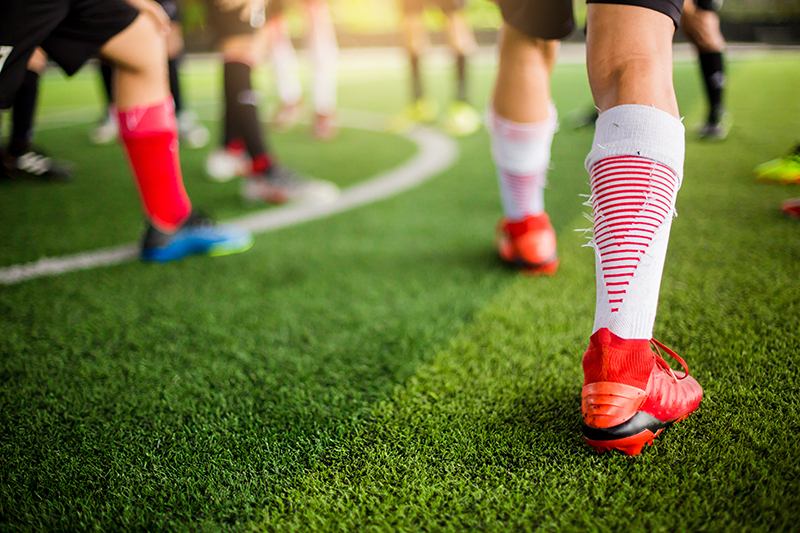
Summer in New Jersey means kids are finally outside — travel baseball and softball, swim team, soccer camps, town leagues, and long unstructured afternoons on the trampoline in the backyard. It is the best stretch of the year for young athletes and, in our experience, one of the busiest for pediatric orthopedic offices.
Summer sports and growing bodies are a demanding combination. Children’s bones are still developing, their growth plates are still open, and their training loads often jump sharply once school lets out. That mix produces a predictable set of injuries every year.
Baseball and softball pitchers develop Little League shoulder and elbow from overuse, and some sustain microfractures. Swimmers develop shoulder irritation when the muscles around the joint are not balanced for the volume of overhead work. Runners report knee and heel pain. Playgrounds and backyard trampolines send us fractures and muscle strains — often enough that we can nearly predict which Monday mornings will be busy.
Most of it is preventable. Below are the seven rules our specialists come back to most often — we call them the 7Ss.
Why Growing Bodies Are Different
Before the rules, the reason behind them.
Children are not smaller adults. Each long bone contains a growth plate, or physis, where new bone forms and lengthening happens. Growth plates are softer and more vulnerable than the surrounding bone and ligaments — which means a force that produces a sprain in an adult can produce a fracture in a child. Ankle injuries are a good example: they rank among the most common pediatric sports injuries and among the most frequent growth plate injuries we see.
Children also have a thick outer lining around their bones called the periosteum, which helps stabilize fractures, and they can remodel — gradually reshaping and correcting alignment as they grow. Their bones heal faster than adult bones. But that same physiology means a mismanaged injury can affect growth, alignment, and long-term joint function.
Growth spurts add another layer. When bones lengthen faster than muscles and coordination can adapt, balance and mechanics temporarily suffer. That is when tendon and growth plate problems tend to show up.
All of which is to say: prevention for a growing athlete is not just a scaled-down version of adult training advice.
Rule 1: SHOES
Or more broadly, equipment.
Kids outgrow cleats, pads, and helmets fast — often within a single season. Gear that fit at the start of spring may not fit by July. Start with well-fitting equipment and re-check it: cleats with proper support and fit, helmets that sit level and do not shift, pads that cover fully while still allowing full range of motion.
Poorly fitted footwear is not a minor issue. It alters mechanics, causes blisters, and contributes directly to foot and ankle injuries. Replace outgrown shoes rather than getting one more season out of them.
Rule 2: STRUCTURE
Every child’s body is built differently, and some builds are better suited to certain sports and positions than others.
Talk with your child’s physician or coach about which sports and positions match your child’s bone and muscle structure. An athlete with loose ligaments, for example, may do better at third base than on the mound. Matching structure to role reduces the risk of serious injury without asking a child to give up the sport.
This conversation is especially useful for kids trying something new, or for athletes who keep getting hurt in the same way.
Rule 3: STRETCHING
Flexibility matters, and in our practice most kids do not stretch enough.
Before activity, use a dynamic warm-up: light walking or jogging to raise the heart rate, followed by active movements that take the joints through their full range of motion. This increases blood flow, raises tissue temperature, and prepares muscles for the demands ahead. Save longer static stretching for after activity, when it supports recovery and flexibility.
The practical version for a summer team: the warm-up belongs at the start of every practice, run by the coach, every session. Prevention work that depends on kids doing it independently does not happen reliably.
Rule 4: SPEED
Ramp up slowly. This is the single most common mistake we see in summer athletes.
After a slower stretch of the year, kids often go straight into practices several times a week, weekend tournaments, or two teams at once. That sharp escalation is a major driver of overuse injuries — and it shows up in the early and mid-season, not at the end.
A reasonable approach: start at roughly half of your child’s previous activity level and increase by about 10 percent per week. Getting back into competitive shape takes about six weeks. Building that ramp into the summer calendar prevents the injuries that otherwise end the season in July.
Related rule: avoid playing on two teams in the same sport during one season.
Rule 5: STRENGTH
Strength and conditioning protect joints, but for growing athletes the progression matters as much as the work itself. Loading too aggressively risks injury to tendons and growth plates.
Our general guidance for strength training: find the weight your child can lift once in good form, and start at 80 percent of it. For a young athlete who can lift 20 pounds, that means starting at 16. Then follow the Rule of Three — three repetitions per workout, three days a week — and increase by about 10 percent per week.
The same principle applies to bodyweight work like squats and push-ups, not just weights. Form first, volume second, load last. If your child has an injury history or is in the middle of a growth spurt, check with your pediatric orthopedist before starting a program.
Rule 6: SURFACE
Where your child plays matters more than parents usually expect.
Uneven sidewalks, cracked pavement, and rocky fields are prime territory for sprained ankles, falls, and back pain. Hard surfaces contribute to shin splints and stress fractures, particularly in runners increasing their mileage over the summer.
Push for even surfaces or ones designed to absorb shock — a high school track, or a field that has actually been cleared of rocks and debris. And if your child is training on their own, pay attention to where those miles are happening.
Rule 7: SUPPER
Growing athletes need real nutritional support, especially during growth spurts, when the body is demanding energy for both growth and activity.
Plan meals ahead and keep good snacks available — fruit, nuts, cheese, whole grains, low-sugar granola bars. Kids generally need to eat more during an active sports season than they do the rest of the year, simply to replace what they burn.
Hydration deserves particular attention in a New Jersey summer. Send water, and make sure there is a place to refill it. Dehydration and heat contribute to fatigue, and fatigue degrades mechanics — which is how a tired athlete in the fourth inning ends up with an injury that had nothing to do with contact.
Two Habits That Matter as Much as the 7Ss
Never play through pain. Teach your child to listen to their body and speak up — to you and to their coach. Kids play through pain because they do not recognize the seriousness of an injury and do not want to let the team down. That instinct turns manageable problems into season-ending ones. Persistent elbow or shoulder pain in a pitcher should never be treated as a normal part of playing baseball.
Protect rest. Build in at least one to two rest days per week, and a full month per year away from sports. Encourage multi-sport participation instead of year-round specialization — rotating sports and positions distributes stress rather than concentrating it in the same joints. And do not skimp on sleep; extra activity requires extra recovery.
When to Have Your Child Evaluated
Have your child seen by a pediatric orthopedic specialist for:
- Pain that does not improve with rest, or that recurs with activity
- Persistent or new joint swelling
- Difficulty bearing weight, limping, or favoring one side
- Limited range of motion in an arm or leg
- A joint that gives out or feels unstable
- Sharp, stabbing pain during activity, or a painful pop
- Numbness, tingling, or weakness
- Decreased throwing performance or complaints of arm heaviness
For severe injuries — open fractures, obvious deformity, heavy bleeding, or head trauma — go to your nearest emergency room or call 911.
For recent acute injuries that are not life-threatening, our urgent care walk-in clinic in Cedar Knolls provides same-visit evaluation by a pediatric orthopedic specialist with X-rays on site, so families skip the emergency room wait and the referral out to an orthopedist afterward.
Schedule a Consultation with The Pediatric Orthopedic Center
Summer sports and growing bodies work well together when the training respects the biology. Gear that fits, a gradual ramp, real warm-ups, sensible surfaces, good food and water, and honest communication about pain will prevent the majority of what we treat every July and August.
The Pediatric Orthopedic Center has led pediatric orthopedics in northern New Jersey for more than 30 years. Our board-certified and board-eligible pediatric orthopedic surgeons treat only children and adolescents, which means every treatment plan accounts for growth plates, skeletal maturity, and what your child needs to get back to — this season and long after.
If your young athlete is hurting, or you want a nagging problem addressed before the fall season starts, call 973-538-7700 or request an appointment online.