National Soccer Day
Every July 28, National Soccer Day celebrates the world’s most popular sport — and in New Jersey, few sports draw more kids onto the field. Travel clubs, rec leagues, school teams, and backyard scrimmages keep young athletes running, cutting, and competing nearly year-round, and interest has only grown with the sport’s rising profile in the United States.
At The Pediatric Orthopedic Center, National Soccer Day is also a good moment to talk about the other side of the game. Soccer is a fast, dynamic sport built on sudden stops, sharp changes of direction, jumps, and collisions, and that combination puts real stress on growing bodies. Our specialists treat these injuries every season, from ankle sprains and strains to fractures and ACL tears.
The encouraging news for parents: many of these injuries are preventable. Understanding where the risk comes from — and building a few habits into your child’s routine — is the most effective way to prevent soccer injuries and keep young athletes on the field instead of on the sidelines.
Common Soccer Injuries in Youth Athletes
Injuries in youth soccer tend to fall into predictable patterns, which is exactly why prevention works.
Knee injuries. The knee absorbs enormous force during twisting, pivoting, and landing. Knee sprains involve overstretching of the ligaments that hold the joint together. Meniscal tears damage the cartilage that cushions the knee, often producing a pop at the moment of injury followed by swelling and a sensation that the knee is giving way. Kneecap bursitis, patellar instability, and growth-related anterior knee pain are also common in young players.
ACL injuries. An ACL tear is among the most serious injuries in soccer and can keep an athlete out for six to nine months. Most of these injuries are non-contact — a sudden deceleration, an awkward landing, or a quick cut is enough. Female athletes face a meaningfully higher risk than their male counterparts, a difference researchers attribute to anatomy, landing mechanics, and neuromuscular control.
Fractures. Traumatic fractures come from direct impact and frequently involve the foot, ankle, wrist, or collarbone. Stress fractures develop gradually from repetitive load, most often in the tibia, fibula, and metatarsals. Because children’s growth plates are softer than the surrounding ligaments, a force that would produce a sprain in an adult can produce a fracture in a child — one of the clearest reasons young athletes need evaluation by a pediatric specialist.
Sprains and strains. Ankle sprains, pulled hamstrings, and muscle strains are the everyday injuries of soccer, and they are the ones most responsive to good warm-up and conditioning habits.
Overuse injuries. Shin splints, patellar tendinitis (jumper’s knee), tendonitis, and stress fractures all stem from repetitive stress rather than a single moment of trauma. These have become more common as year-round play and early specialization have grown.
Head injuries. Concussions occur in soccer from ball contact, collisions, and head-to-ground impacts, with goalkeepers at particular risk. Facial fractures, lacerations, and eye injuries also occur.
Importance of a Preseason Sports Physical
Preseason sports physicals are one of the simplest and most overlooked prevention tools available to families. Most New Jersey schools and leagues require one, and it is worth treating as more than a form to sign.
A thorough preparticipation exam reviews your child’s injury history, current pain or limitations, general health, and readiness for the demands of the season. That history matters: a previously sprained ankle, an ACL reconstruction, or a knee that still swells after activity all change how an athlete should prepare. Sports physicals are also an opportunity to flag imbalances and weaknesses — tight hamstrings, weak hips, poor single-leg balance — before they turn into an injury in week three of the season.
Schedule the exam several weeks before tryouts rather than the day before. That leaves time to address anything that comes up, whether that means physical therapy, a strengthening program, or a specialist evaluation for a lingering problem. If your child has an unresolved injury from a previous season, a pediatric orthopedic evaluation before the season starts is one of the most effective ways to prevent soccer injuries from recurring.
5 Essential Soccer Equipment & Gear Rules
Equipment will not eliminate risk, but the right gear, properly fitted, reduces it.
- Wear soccer shoes with molded cleats. Proper traction and support reduce awkward slips and twisting forces on the ankle and knee. Cleats should be sport-appropriate, not hand-me-downs a size too large.
- Replace outgrown footwear. Ill-fitting shoes cause blisters, alter mechanics, and contribute to foot and ankle injuries. Children’s feet change quickly during growth spurts — check fit each season.
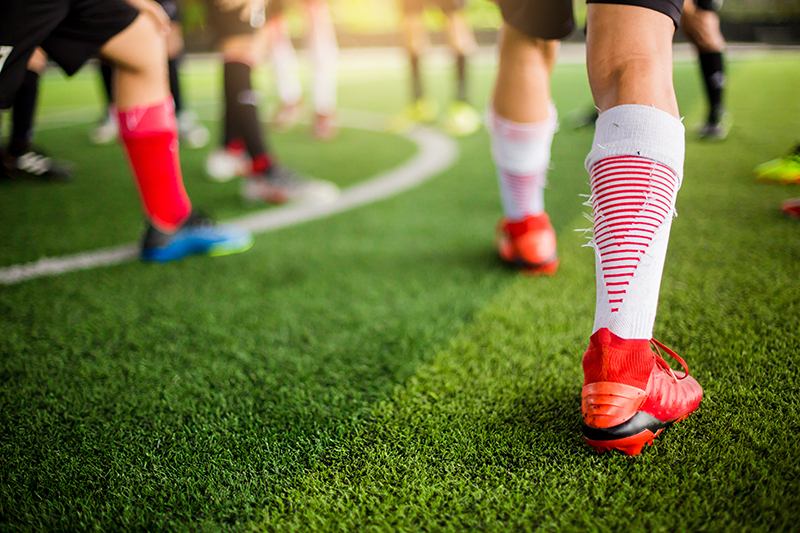
- Always use shin guards. Shin guards protect against direct impacts and collisions and should cover the full length of the shin without shifting during play. Field players and keepers alike should wear them at every practice, not only at games.
- Add braces or taping where recommended. Athletes returning from an ankle sprain or with a history of patellar instability often benefit from bracing or taping. Follow your physician’s or physical therapist’s recommendation rather than guessing.
- Consider protective headgear. Padded headgear and mouthguards can reduce the risk of facial injury and are worth discussing for players at higher risk, including goalkeepers.
Warm-Up and Conditioning Exercises
Conditioning is the part of prevention with the strongest evidence behind it, and it is largely free.
Before play, use a dynamic warm-up — movement-based stretching that raises the heart rate and prepares the muscles the game will demand. Target the calves, hamstrings, quadriceps, hips, and lower back. Save static stretching for after the game, when it helps with recovery and flexibility.
Beyond warm-ups, a year-round strength routine builds the stability that protects joints. The exercises we most often recommend for young soccer players are:
- Single-leg squats — develop leg strength, balance, and coordination, all of which support safer landings.
- Calf raises — strengthen the calves and improve flexibility, reducing ankle and foot injury risk.
- Side planks — stabilize the core and improve hip control and movement efficiency.
- Glute bridges — improve hip extension, core stability, and posture.
- Ankle hops — build speed, power, and ankle flexibility for cutting and kicking.
For athletes in high-risk sports, structured neuromuscular training programs — which teach proper jumping, landing, cutting, and pivoting mechanics — are especially valuable. These programs have become a standard recommendation for reducing non-contact ACL injuries, and they benefit both boys and girls.
Build intensity gradually, particularly after an off-season break. Sudden jumps in training load are one of the most reliable predictors of injury.
Recognizing and Managing Concussions
A concussion is a mild traumatic brain injury that occurs when an impact causes the brain to shift inside the skull. It does not require losing consciousness, and it does not require a direct hit to the head.
Concussion symptoms parents and coaches should watch for include:
- Headache, dizziness, or nausea
- Confusion, difficulty concentrating, or memory problems
- Sensitivity to light or noise
- Sleep disturbances
- Mood changes, irritability, or unusual emotional responses
- Fatigue or feeling “off”
Symptoms may appear immediately or develop over hours. Any athlete with suspected concussion should be removed from play right away and evaluated by a medical professional — there is no version of “shake it off” that is safe here.
Recovery depends on rest and a supervised, gradual return to activity. Athletes should not return to play until a clinician has confirmed the brain has healed, and younger athletes and female athletes often need longer recovery periods. Returning too soon raises the risk of a second injury while the brain is still vulnerable. For severe head trauma, loss of consciousness, repeated vomiting, or worsening symptoms, go to the emergency room or call 911.
Encouraging Rest, Recovery, and Hydration
Rest is training. Overuse injuries develop when tissue breaks down faster than the body can rebuild it, and the fix is built into the calendar rather than the training plan.
- Schedule at least two rest days per week. These are non-negotiable for growing athletes.
- Take time off from soccer each year. An extended break from a single sport gives overworked tissue time to recover.
- Cross-train. Playing multiple sports distributes stress across different muscles and joints and builds broader athleticism. Early single-sport specialization is one of the clearest risk factors for overuse injuries.
- Prioritize sleep. Fatigue degrades coordination and landing mechanics, and fatigue-related injuries tend to cluster late in games and late in the season.
- Hydrate before, during, and after play. Dehydration contributes to cramping, fatigue, and reduced performance, especially during summer tournaments and August preseason.
If your child complains of pain that improves with rest but returns with activity — a hallmark of a stress fracture or tendinitis — do not wait for it to worsen. Persistent or recurring pain deserves evaluation.
How To Increase Awareness in Soccer (National Soccer Day)
National Soccer Day is a natural opportunity to make injury prevention part of the conversation in your league or club. A few ways families, coaches, and organizations can help:
- Make warm-ups mandatory, not optional. Coaches who build a dynamic warm-up and neuromuscular training block into every practice change outcomes for the whole roster.
- Share what concussion symptoms look like. Parents, coaches, and players themselves should all be able to recognize them. Athletes who understand the risk are more likely to report symptoms instead of hiding them.
- Normalize rest days. Culture matters. When coaches and parents treat recovery as part of the commitment, athletes stop viewing time off as falling behind.
- Talk about ACL prevention with girls’ teams specifically. Given the elevated female athlete ACL risk, prevention programming deserves dedicated attention.
- Use the day to check gear. A team equipment check — cleats, shin guards, fit — is a simple National Soccer Day activity with real benefit.
- Post and share. Use #NationalSoccerDay to spread prevention resources through your club’s social channels and parent groups.
Schedule a Consultation with The Pediatric Orthopedic Center
Children are not small adults. Their bones are still growing, their growth plates are still open, and their injuries heal — and can go wrong — differently. That is why soccer injuries in kids and teens deserve care from specialists who treat only children and adolescents.
The Pediatric Orthopedic Center has been a leader in pediatric orthopedics in northern New Jersey for more than 30 years. Our board-certified and board-eligible pediatric orthopedic surgeons manage the full range of youth soccer injuries, from ankle sprains and strains to complex fractures and ACL reconstruction designed to protect growing bones, along with prevention guidance and return-to-play planning.
You should have your child evaluated for:
- Suspected concussion
- Suspected ACL or other ligament tears
- Obvious or suspected fractures
- Significant swelling, numbness, or tingling
- Difficulty bearing weight or inability to move a limb normally
- Lingering, recurring, or worsening pain
For recent, acute injuries such as a suspected broken bone, sprain, or strain from a fall or a game, our urgent care walk-in clinic in Cedar Knolls offers evaluation by a pediatric orthopedic specialist with on-site X-rays — no emergency room wait, and no referral out to an orthopedist afterward. For severe injuries including open fractures, obvious dislocations, heavy bleeding, or head trauma, go to your nearest emergency room or call 911.
Whether your young athlete needs an injury evaluated, a nagging problem sorted out before the season, or a plan to prevent soccer injuries going forward, our team is here to help. Schedule a consultation with The Pediatric Orthopedic Center today.